
Naujas LOD žurnalo „PAUKŠČIAI“ numeris
Pasirodė naujas LOD žurnalo „PAUKŠČIAI“ Nr.35. Šiuo metu galite susipažinti su jo turiniu.
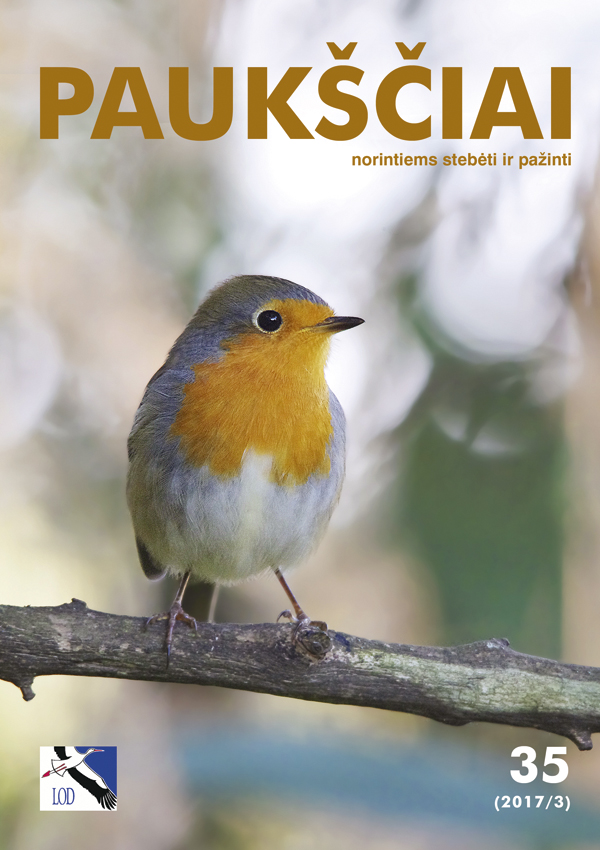
Viršelyje: Liepsnelė (Erithacus rubecula). Juozo Baškio nuotrauka
Pasirodė naujas LOD žurnalo „PAUKŠČIAI“ Nr.35. Šiuo metu galite susipažinti su jo turiniu.
Viršelyje: Liepsnelė (Erithacus rubecula). Juozo Baškio nuotrauka
Šių metų rugsėjo 30 d., ir spalio – 1 dienomis, Lietuvos ornitologų draugija (LOD) tradiciškai kviečia visus gamtai ir paukščiams neabejingus žmones prisijungti prie gausaus stebėtojų būrio išlydėti išskrendančius paukščius. Kiekvienais metais dalyvauja daugiau nei 30 šalių paukščių skaičiavime. Tūkstančiai žmonių tomis dienomis stebės ir mėgins suskaičiuoti daugelyje Europos vietų stebimus migrantus. Vėliau tarptautinė paukščių apsaugos organizacija BirdLife International, kurios partnerė yra Lietuvos ornitologų draugija, apibendrins ir paviešins šios Europinės akcijos rezultatus, kurie parodys ir kiekvienos šalies indėlį. Šis tarptautinis visuotinas renginys skaičiuoja jau 23– uosius metus.


Lietuvos ornitologų draugija
Įmonės kodas: 191692933, PVM kodas: LT100007641219, adresas: Naugarduko g. 47-3, LT-03208 Vilnius, tel./faks. (8 5) 213 04 98, el. paštas: [email protected]
Įgyvendindama ES aplinkos finansinės programos LIFE+ finansuojamą projektą „Lietuvos pažeistų durpynų tvarkymas, įgyvendinant Tyrulių paukščių apsaugai svarbių teritorijų (PAST) atkūrimo darbus“, Nr. LIFE12 NAT/LT/001186
SKELBIA KONKURSĄ

Lietuvos ornitologų draugija su partneriais – Pajūrio planavimo ir tyrimų (PPTI) bei Lietuvos energetikos institutais (LEI), nuo 2015 m. vasario mėnesio 2009–2014 m. Europos ekonominės erdvės finansinio mechanizmo LT03 programos „Biologinė įvairovė ir ekosistemų funkcijos“ ir nuosavomis lėšomis įgyvendino projektą „Vėjo energetikos plėtra ir biologinei įvairovei svarbios teritorijos (VENBIS)“.

Since February 2015, the Lithuanian Ornithological Society (LOD) in cooperation with the partners – Coastal Research and Planning Institute (CORPI) and Lithuanian Energy Institute (LEI) was implementing the project “Development of wind energy and territories important to biodiversity” (VENBIS), which was financed by the EEA grants, project partners as well as national contribution.
According to the National Energy Independence Strategy, Lithuania will aim to reach the target of no less than 23 % of renewable energy in final energy consumption, including no less than 20 % of renewable energy in the electricity sector by 2020. In order to reach this goal, in 2020 Lithuania will have installed wind energy (WE) power plants of 500 MW capacity. At the moment, the development of WE, particularly in the western part of Lithuania, often leads to the conflicts with territories, important to the protection of biodiversity. There is a lack of effective mechanisms for the conflict management, since the actual data on biodiversity, abundance, state of populations of the sensitive to WE development bird and bat species is still poor.
Since February 2015, the Lithuanian Ornithological Society (LOD) in cooperation with the partners – Coastal Research and Planning Institute (CORPI) and Lithuanian Energy Institute (LEI) implementing the project “Development of wind energy and territories important to biodiversity” (VENBIS), which is financed by the EEA grants, project partners as well as national contribution.
Since February 2015, the Lithuanian Ornithological Society (LOD) in cooperation with the partners – Coastal Research and Planning Institute (CORPI) and Lithuanian Energy Institute (LEI) implementing the project “Development of wind energy and territories important to biodiversity” (VENBIS), which is financed by the EEA grants, project partners as well as national contribution.
The main issue of conservation is the lack of data about distribution, abundance and , in particular, exact location of findings of protected species. Although they are often identified, all information is found in the notes of individual researchers or in private archives. Therefore, the data on protected species, if not published or recorded on special data basis or information systems, are not used planning general type of protection measures and cannot guarantee that species found by individual observers can be protected by the Law on protected species of the Republic of Lithuania, or other national or international law. This problem is particularly acute while planning economic activities (even in accordance with the appropriate procedures), particularly during spatial planning. If data on rare species sites are discovered after approving spatial or other planning documents, it is often impossible to protect sites of endangered species, or it causes conflict situations with land users or developers. However, this problem can be easily solved by publishing data of individual researchers or naturalists with exact sites of protected species, abundance and status of local populations.
In the period 2015 January – 2017 April the LOD was implementing project “Data on protected species – for their protection” NO. EEE-LT03-AM-01-K-01-002, supported by the EEA grants, when thousands of records were entered into the Information System of Protected Species (SRIS), which is created and supervised by the Ministry of Environment. The main aim of the project was to collect all available, including historical, data about the exact sites of protected species all over the country from numerous researchers and to enter the data into the Information System of Protected Species (SRIS) thus to increase the level of the biodiversity protection in Lithuania.